How to reduce echo in a room and plan acoustic panels
When voices keep ringing around the dining table or the television sounds less clear in a sparsely furnished room, reflected sound may be part of the problem. Start by looking at the surfaces around you, then plan changes that suit both the room and its daily use.
4 min read · Updated 1 October 2026
Key takeaways
- Identify reverberation before choosing a product
- Combine panels with other suitable absorbing surfaces
- Floor area alone cannot determine a panel count
- Plan, listen and adjust, or ask for an acoustic assessment
1. Check whether the problem is reflected sound
Listen to ordinary speech from the sofa, the dining table or your desk. Reverberation is the sound that lingers as reflections return from surfaces. A handclap can make those reflections easier to notice, but it is not a calibrated measurement and does not reliably identify one wall as the only cause.
If the main problem is traffic, footsteps upstairs or voices through a wall, sound absorption is only part of the picture. Those problems can require work on the noise source or the building's sound insulation.
2. Look at the whole room
Bare plaster, glazing, a hard floor and a large table can all contribute reflections. Rugs, curtains and upholstered furniture can add absorption while changing the room's colour and texture. Their effect varies with the material and the frequencies involved.
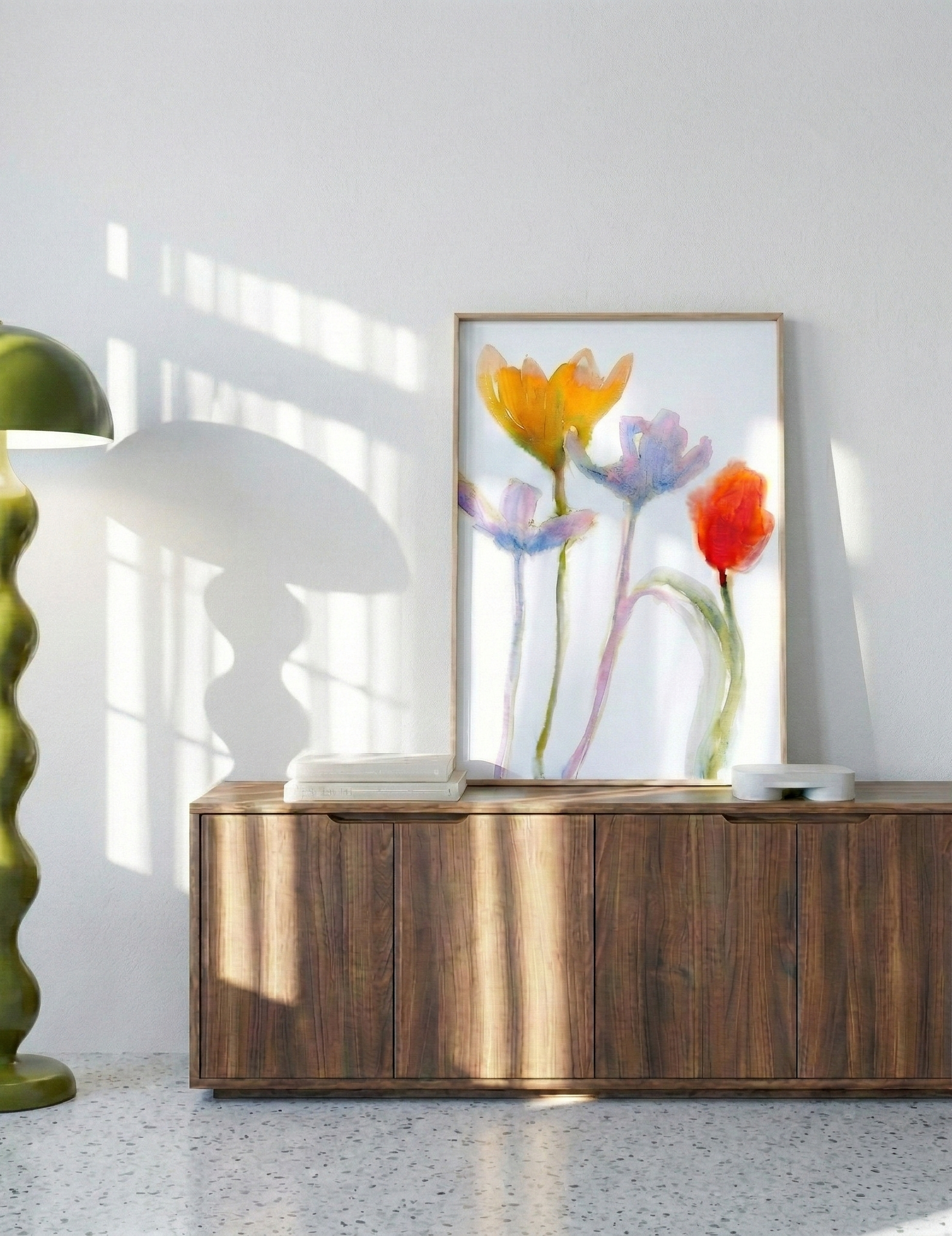
Acoustic wall art adds another absorbing surface where furniture or textiles may not fit. It can be planned as part of the interior rather than added only after everything else is chosen.
3. Work out what a panel area means
There is no universal panel count for a room of a given floor area. Ceiling height, room shape, glazing, furniture, panel performance and your desired result all affect the amount needed.
You can still compare physical coverage. A set of two 60 × 60 cm panels has 0.72 m² of front surface; two 60 × 80 cm panels have 0.96 m²; two 70 × 110 cm panels have 1.54 m². These are geometric areas, not measured acoustic absorption areas or a promise of a particular result.
4. Choose useful positions
Look for exposed hard walls near the areas where conversations happen. Keep the panel faces clear of tall furniture. In an open-plan room, consider more than one area instead of assuming that one composition treats the entire space.
Use removable tape to mark the composition, including gaps between panels. Check the wall construction and mounting instructions. The location needs to make visual and practical sense as well as leave the material accessible to sound.
5. Review the result
After making changes, listen from the same positions during normal use. Start with the question that prompted the work: does conversation still linger, or is the remaining problem a separate noise source?
If you need a specified reverberation time, are fitting out a large room or are unsure about the amount of treatment, ask an acoustic professional for measurements and a plan. A photograph and floor dimensions alone cannot establish an exact acoustic outcome.
Ready to act on your acoustics?
Start with a single panel on the most critical reflection wall. You'll hear the difference immediately.
Frequently asked questions — how to reduce echo in a room
Related guides
Read more guides4 min read
How to choose acoustic wall art
Choose acoustic wall art by material, size, colour and position. A practical guide to felt wall art and sound absorption in a furnished room.
Read guide
4 min read
Choosing decorative acoustic wall panels
Compare decorative acoustic wall panels by material, mounting and design. Discover how 3D felt panels combine wall art with sound absorption.
Read guide
3 min read
Acoustic panels for your home office
Plan acoustic panels around your desk or meeting table. Consider hard surfaces, panel placement and a design that fits your workspace.
Read guide